HomeBase is still taking shape and updated daily. We'd love your feedback.


Hmm, something went wrong while submitting the form. This may be a connection issue. Please try again.
Understanding your financial options is one of the most important steps in planning for community living. Public benefits, savings tools, and waivers can make housing possible, this section explains each one. These systems are complicated, and figuring them out takes time, for anyone. But most people find that once they understand what's available, the picture gets clearer and real possibilities open up. This section is here to help with that.
Go to Plain Language Summaries
The Arc has prepared a set of videos and written explainers (including “plain language” summaries) that outline many of the important things to do when planning to live outside the family home. These include public benefits, like Social Security and Medicaid, and tools to help you maintain eligibility for income-based benefits, such as Special Needs Trusts and ABLE Accounts (called STABLE Accounts in Georgia).
To get more detailed information about these topics, click on the links below.
In addition to managing retirement benefits for seniors, the Social Security Administration (SSA) administers the Supplemental Security Income program, or SSI. Both children and adults with disabilities are potentially eligible for SSI, though the criteria for eligibility are different for adults and children.
Currently, SSI payments are just under $1,000 per month for an individual. While this is not enough to afford market-rate housing (and pay for other essentials) anywhere in Georgia, SSI benefits can be an important part of paying for community living.
Individuals with disabilities can receive SSDI benefits when a parent passes away, becomes disabled, or retires and starts drawing retirement benefits.
Unlike SSI, which is based on the income and resources of the person with the disability, the amount of SSDI payments is based on the lifetime earnings of the parent (wage earner).
An Adult Dependent Child who has been determined disabled by Social Security may receive a monthly amount up to one-half of their parent’s Social Security retirement benefit. Often this can be substantially more than what they would receive under SSI. Adult Dependent Children are eligible for Medicare after 24 months.
Often the Adult Dependent Child loses SSI because the SSDI amount exceeded SSI eligibility and will lose SSI straight Medicaid as well. It is important to file for Medicaid as a Dependent Adult Child to continue to have access to Medicaid. The $2,000 resource limit is still applicable for Medicaid.
Medicaid is a medical assistance program. Services like doctor visits, medications, and hospital stays are covered, though not all medical providers accept Medicaid.
After reaching 18 years of age, individuals with developmental disabilities may apply for SSI benefits without regard to family income. When an individual is awarded SSI benefits, they are also automatically approved for Medicaid services.
In Georgia, the Medicaid program is administered by the Department of Community Health (DCH).
The Home and Community Based Services (HCBS) Medicaid Waivers provide funding for support services to allow people with disabilities to live in the community.
Anna Maki, the Director of Benefits Navigation at the Bobby Dodd Institute, has written a comprehensive blog post that explains each of the waiver programs, the services they cover, and how to apply.
Special Needs Trusts (SNTs) are a legal mechanism to set aside resources (e.g. benefits from a life insurance policy or bequests from a relative) for the benefit of a person with a disability without affecting their eligibility for government benefits.
Creating a standalone trust requires hiring an attorney and can be costly. Also, some companies that manage a trust may require a hefty minimum amount of funds in the trust. An alternative for families with limited resources is a “pooled trust” or “community trust.”
The Bobby Dodd Institute administers a community trust (pooled trust) in Georgia that provides an affordable alternative to standalone trusts:
ABLE Accounts (also called STABLE Accounts in Georgia) are tax-advantaged savings accounts for individuals with disabilities that don’t affect eligibility for public benefits.
Eligibility for most government benefit programs, like SSI and SNAP, have income limits and/or savings limits, meaning you can lose some or all your benefits if your income is too high or you have too much in savings. “Income” can be money you earn or money you receive from family and friends.
If family or friends contribute to your STABLE account and then you pay expenses from your STABLE account, their contribution does not affect your income level for determining benefit eligibility.
The Supplemental Nutrition Assistance Program (SNAP), formerly known as “Food Stamps,” is a federally funded program that provides funds to low-income households for purchasing groceries. This assistance can be an important component of the budget for community living, especially for those who have little or no income beyond their SSI or SSDI benefits.
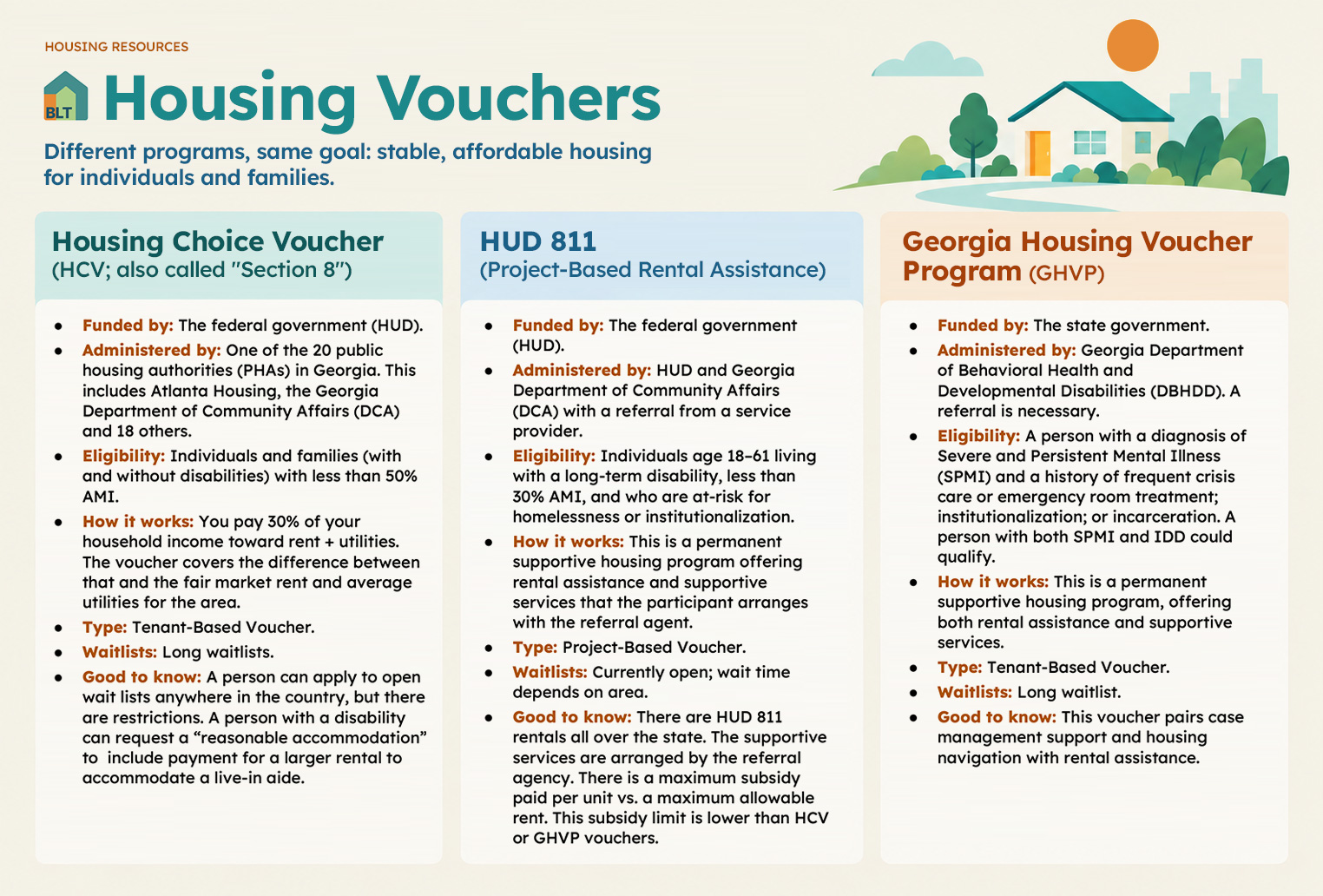
A Housing Voucher helps people with lower incomes rent an apartment at market rate by covering the gap between what they can afford and what the apartment costs. A voucher can be one of the most helpful forms of housing assistance available, but it is also one of the hardest to get.
Following is an overview of three voucher programs that can help people with disabilities afford housing. You can read more about housing vouchers on the DIY Options page.
For more detailed information about these topics, visit The Arc’s comprehensive financial planning resources.
Short, plain-language descriptions of every topic on this page.